Today we leave Arequipa to head into Colca Canyon.
Surrounding Arequipa are the slums. Terrorism was once very bad in Peru, especially in Arequipa where the terrorists could safely stay in the slums surrounding the city.
When Fujimori was in power, he removed the terrorists. He also vastly improved the economic status of Peru. However, his rule was also very corrupt, and he is in jail today.
On the way to Colca Canyon we drive through an area with lots of vicuñas. These animals produce the finest wool in the world, but can only be shorn once every 3 years. This makes their wool extremely expensive. In Incan times, only royalty were allowed to wear it.
Here we drive past a mountain that has been worn by wind erosion.
And we stop by a tea cafe on the way.
I try the chachacoma.
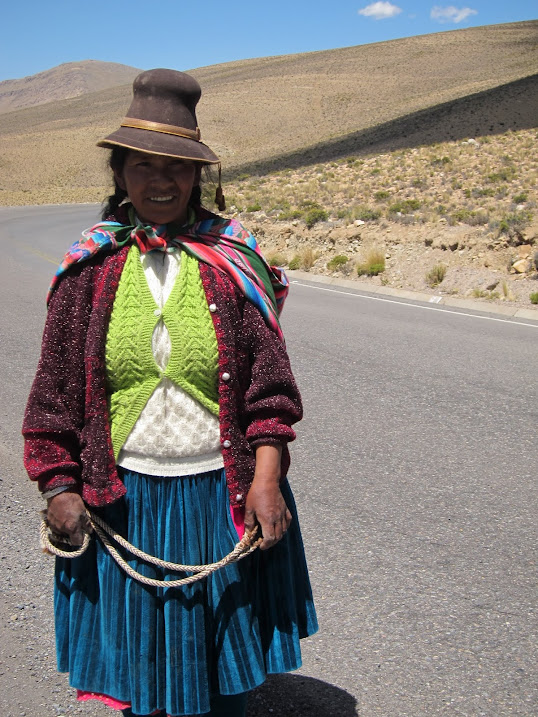
Continuing on our way, we find a shepherd on the side of the road with a flock of alpacas and llamas.
You can see she is holding a sling. There are rocks literally everywhere and she knows how to use it. At night she will round the camelidae up in a stone pen to help protect them from pumas that roam. A single puma can be known to kill up to 7 camelidae in one night for the fun of it.
Llamas have taller ears, thinner faces, and longer faces than alpacas, and their tails stand up, while alpaca's tailes droop.
Here she is feeding a young llama. Llama meat is good for jerky. They use it for this in rural areas.
Mama and baby
alpaca sheep. Alpaca meat is very good if well washed. However, if it hasn't been, it tastes like one of the plants the alpaca eat: Toca.
Dogs are very common in Peru and are very useful in herding the camelidae. They help coral them into the stone pens at night.
I have mentioned coca leaves before. They are a very important part of the Peruvian culture. They are often used in offerings. Three coca leaves is one offering. One is for the apus (mountains), one for the Inti (the sun), and one is for the Pachamama (the earth).
As we continue on the drive we see a lot of formations of volcanic rock .
And a volcano. I *think* this is Chocura Volcano. Trying to match names from what our guides said to information on the internet seems nearly impossible, which is not surprising given the way language has evolved in Peru. It's very common for places to have more than one name, with both Spanish and Quechua variations.
We take a brief stop where we can see three volcanos: Hualca Haulca, Sabancaya, and Ampato. We are at nearly 5000m above sea level.
Sabancaya to the left and Hualca Hualca to the right in the distance.
You may be wondering about the stacked stones. These are worship offerings to the apus, the mountain gods. There are many, many of these offerings here.
Then it is on to the town of Chivay. Chivay is the local capital of this province.
As is typical, it has its own Plaza del Armas with a church.
A woman is in the center square with her llama for photos. Locals commonly dress in the traditional garb for tips for photos
Just off the main square in Chivay is the local market. I buy a snack here that tastes like frosted flakes.
We continue through the valley to our hotel in a small rural village outside Coporaque.
Again, super nice accomodations!
The "back yard" of the hotel has hammocks set up to view into the valley.
They also have a pet llama alpaca hybrid. Don't try to pet him. He's a spitter, as my brother found out!
Relaxin'.
For lunch we have some barbecued alpaca. It isn't bad.
There is also soup
And a variety of local dishes. I've got four different potato dishes, a quinua salad, and some veggies and cheese.
And piña--pineapple juice!
After lunch we take a hike around the area. The entire valley is filled with terraces. These were built in approximately 800 a.d. Many of the terraces are still being used today. With the terraces, they used different micro climates for different crops. In the highest altitude they grew quinua. Below that were the potatoes. And in the lowest part, in the valley, was maiz, corn. These are all native to Peru. There are canals directing glacial water from the mountain throughout the terraces and into houses for running water.
We also see some old Pre-Incan ruins that are still on the hillside. Pre-Incans built on the hillsides, leaving the fertile valley available for its farming. When the Spanish came, they built their cities in the valleys. It's speculated that the building on this hill was a sort of palace.
That evening, we take a ride over to some nearby hot springs. The water comes out of the ground here at a toasty 85°C. That's the same temperature at which I brew my coffee. The smell of the sulfur is very strong. From here, the water is filtered to clear the sulfur and is naturally cooled by the air to a 38-40°C, what would be a very hot summer day. At this temperature it feels very nice.
These pools have a view across the river to some ruins.
We opt for something less crowded.
That night we go out to look at the sky. Here is the Milky Way.
That's all for this day. Tomorrow is Colca Canyon and condors.